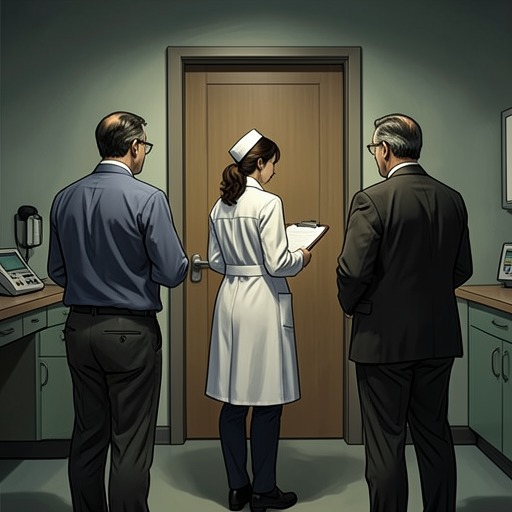
New Jersey Poison Control Center
The Good Nurse: A True Story of Medicine, Madness, and MurderThe New Jersey Poison Control Center enters the account as an outside source of pharmacological expertise when Somerset Medical Center seeks help interpreting unexplained Digoxin levels in two patients. Its pharmacists do more than calculate a dose: Bruce Ruck recognizes that the pattern may signal deliberate harm, and director Steven Marcus urges action while the hospital’s response stalls. The center’s role is therefore both technical and consequential, offering a clear external reading of evidence that the hospital has chosen to handle internally.
Role and Expertise
The center is approached by Nancy Doherty, an assistant pharmacist at Somerset Medical Center, on the instruction of her bosses. The hospital wants help estimating how much Digoxin could produce the concentrations measured in two patients. The consultation is framed as a question of dosage mathematics, but the facts Doherty supplies make it difficult to keep the problem within that narrow frame.
Ruck, a pharmacist at the center, is the first outside professional to hear the details. He shares Doherty’s pharmacy training and understands that she is relaying a serious matter from inside Somerset. His function in the exchange is not to conduct a hospital investigation but to interpret the drug evidence and press its implications. That distinction matters: the center can help determine whether the reported levels make clinical sense, while the decisions about investigating the incidents remain with Somerset and, later, other authorities.
The scene of the consultation makes the contrast between routine service and extraordinary danger visible. Doherty first reaches the center through a recorded greeting and upbeat hold music. When Ruck calls back, he too waits on hold, this time beneath a recorded assurance that patient safety comes first. The ordinary telephone procedure surrounds an increasingly alarming case, as if the danger has arrived by way of a routine inquiry.
The Somerset Cases
On July 7, 2003, Doherty tells the center about two episodes of Digoxin toxicity in Somerset’s Cardiac Care Center. The first patient had coded on June 16; the second, Reverend Florian Gall, had coded on June 28. In small doses, Digoxin helps stabilize heart rhythm, but the levels in these cases were excessive. Gall had been designated Patient 4 by the hospital, which already knew that his death was not an ordinary natural death and that he was not the first patient to die under suspicious circumstances.
Ruck’s questions bring the chronology into focus. When Doherty confirms that both cases occurred on the same unit, he registers the coincidence as alarming rather than incidental. She then reads Gall’s laboratory results: his Digoxin level had been relatively lower on earlier dates, but rose abruptly to 9.61 just after dawn on June 28. The critical detail is that doctors had stopped giving him Digoxin the day before. His level nevertheless climbed a full day after the drug had been discontinued.
Ruck tells Doherty that, on the information she has given him, Gall’s level could not have risen in that way unless he had received more Digoxin. His conclusion does not identify who administered it or establish how it entered Gall’s system. It does, however, contradict an explanation based on the recorded treatment alone and makes the missing exposure central to the case. Ruck wants to consult someone else about the findings because he considers them a major issue.
From Consultation to Warning
The exchange changes character as Ruck moves from calculation to risk recognition. At first he is helping Doherty with the probable quantities involved. Once he hears that two patients on the same unit suffered toxicity from the same drug, and that Gall’s level rose after his prescribed Digoxin had stopped, he reacts with alarm. The center’s expertise gives Doherty’s concerns an independent professional confirmation: the pattern is not merely confusing hospital data but evidence that demands explanation.
Ruck takes the matter to his boss, Poison Control director Steven Marcus. Marcus needs only a brief account before deciding that the data are not ambiguous. He believes someone at Somerset may be deliberately killing patients and warns that the longer the administration waits to acknowledge the facts, the more patients could be harmed. His response enlarges the meaning of the original request: what began as a question about dose becomes a warning about an ongoing threat.
The center’s internal escalation is prompt, but its access to the hospital’s next steps is limited. Doherty says she will brief Somerset’s William Cors and Mary Lund herself and asks Ruck not to come down. Ruck gives her his direct number and waits for a callback. When none comes, he calls the hospital again the following day. Somerset’s head of pharmacy, Stuart Vigdor, tells him that the administration has taken over the investigation. Ruck’s follow-up meets a closed institutional channel rather than a report of what the hospital has decided to do.
Significance in the Investigation
The New Jersey Poison Control Center’s importance lies in the gap between recognizing a dangerous pattern and being able to make an institution act on it. Ruck identifies the contradiction in Gall’s laboratory timeline; Marcus understands its potential human cost. Yet the center does not control Somerset’s internal inquiry, and the promised response never reaches Ruck before he has to seek it himself. Its expertise can clarify what the evidence means, but the account shows that expertise alone cannot ensure disclosure or intervention.
That gap gives the center a distinct place in the wider investigation. The hospital initially treats the matter as an internal problem, while the center’s pharmacists hear a pattern—two Digoxin cases in one unit—and regard it as a grave warning. Their exchange helps make the suspicious nature of the deaths legible beyond Somerset, even as the hospital’s administration takes over and the flow of information narrows. The center is neither the investigating police agency nor the decision-maker inside the hospital; it is the external professional voice that recognizes what the figures imply and presses for the danger to be taken seriously.